

Di Sekitar Kita: Urban Biodiversity Challenge aims to identify and map habitats and biodiversity that we can find in Malaysian cities, especially those that may be “under the radar”, as well as unpacking preliminary insights into the norms, values, attitudes and perceptions of various stakeholders towards urban biodiversity.
Loneliness/Freedom
C: Biasanya, bagaimanakah kau pergi jemput kawan? Guna kereta, ba-
A: Eh, mana ada pergi mana2? Bro, sekarang PKPD la, kita duduk rumah je.
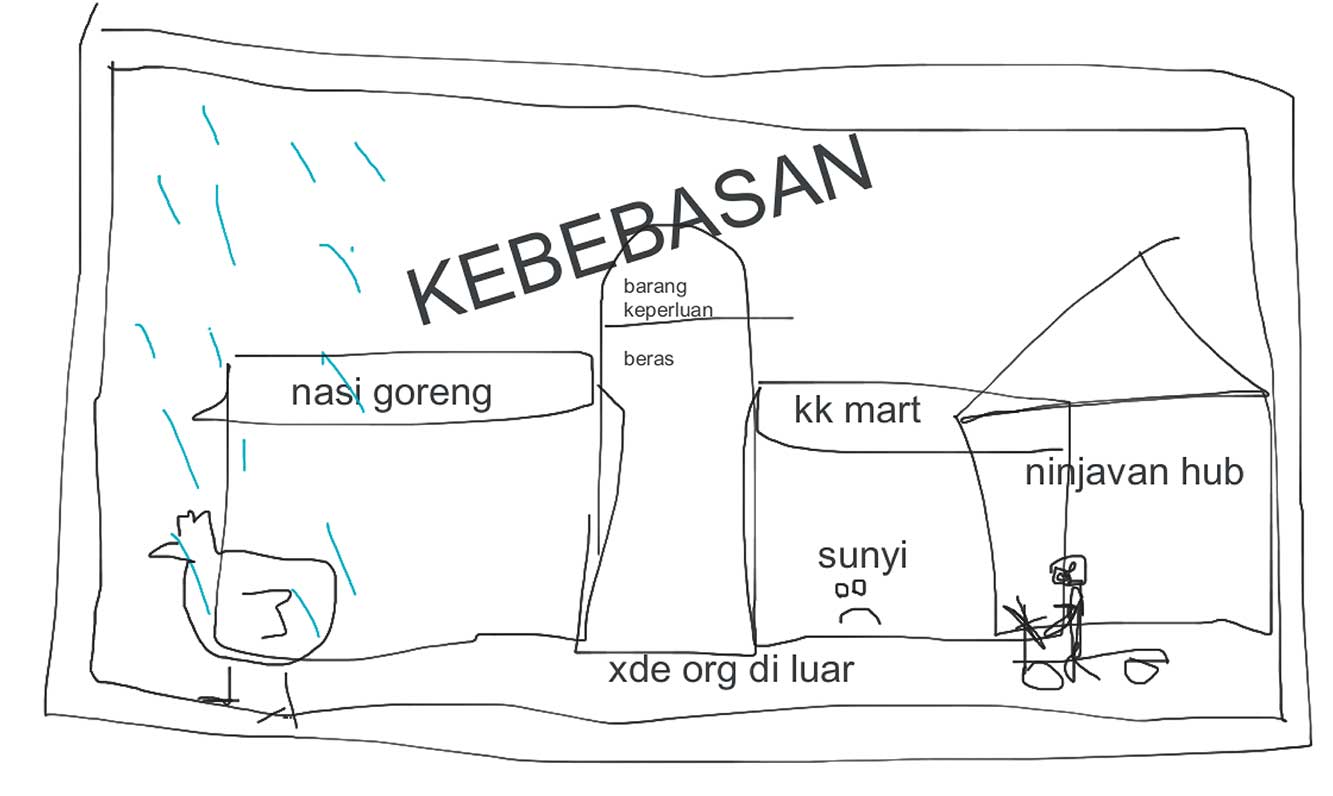
[1] Pemandangan dari tingkap
Movement restrictions had entered a stricter phase during our Community Mapping exercise. Severed from their neighbourhood, “sunyi/kebebasan” (or lonesomeness/freedom) was the first major topic we encountered when working with these students.
Prior to lockdowns, BJCK children generally had a robust social life in Chow Kit: they would hang out at Pasar Chow Kit or in specific alleys, play futsal at Kelab Sultan Sulaiman, visit and sleep over in friends’ houses, and so on.
We began engagement with students on the topic of outdoor spaces, but they often turned downbeat as a result. Being stuck at home was confining, and most students were clearly tired, upset, or restricted. Students often used “sunyi” or “senyap” to describe the atmosphere of the neighbourhood or the view from their window.
As shown in map [1], the world beyond the students’ apartments represented Kebebasan. Essential goods and delivery services dominated the drawings, reflecting life in lock down. KK mart, restaurants, and kedai runcit were the spaces they continued to keep in touch with.
No one drew rivers, shopping malls, mosques, or parks — places where they recalled spending much time before the lockdowns. When talking about the chickens, monitor lizards, or birds outside, some students almost looked on jealously and described the animals as having Kebebasan.
Nature
When discussing animals, students would bring up biawak, anjing, or ayam, but not from an ecological perspective. Instead, these animals represented stories about the outside. In some cases, Nature was represented Kebebasan and the social spaces they played; in other cases, Nature represented undesirable aspects of their neighbourhoods.
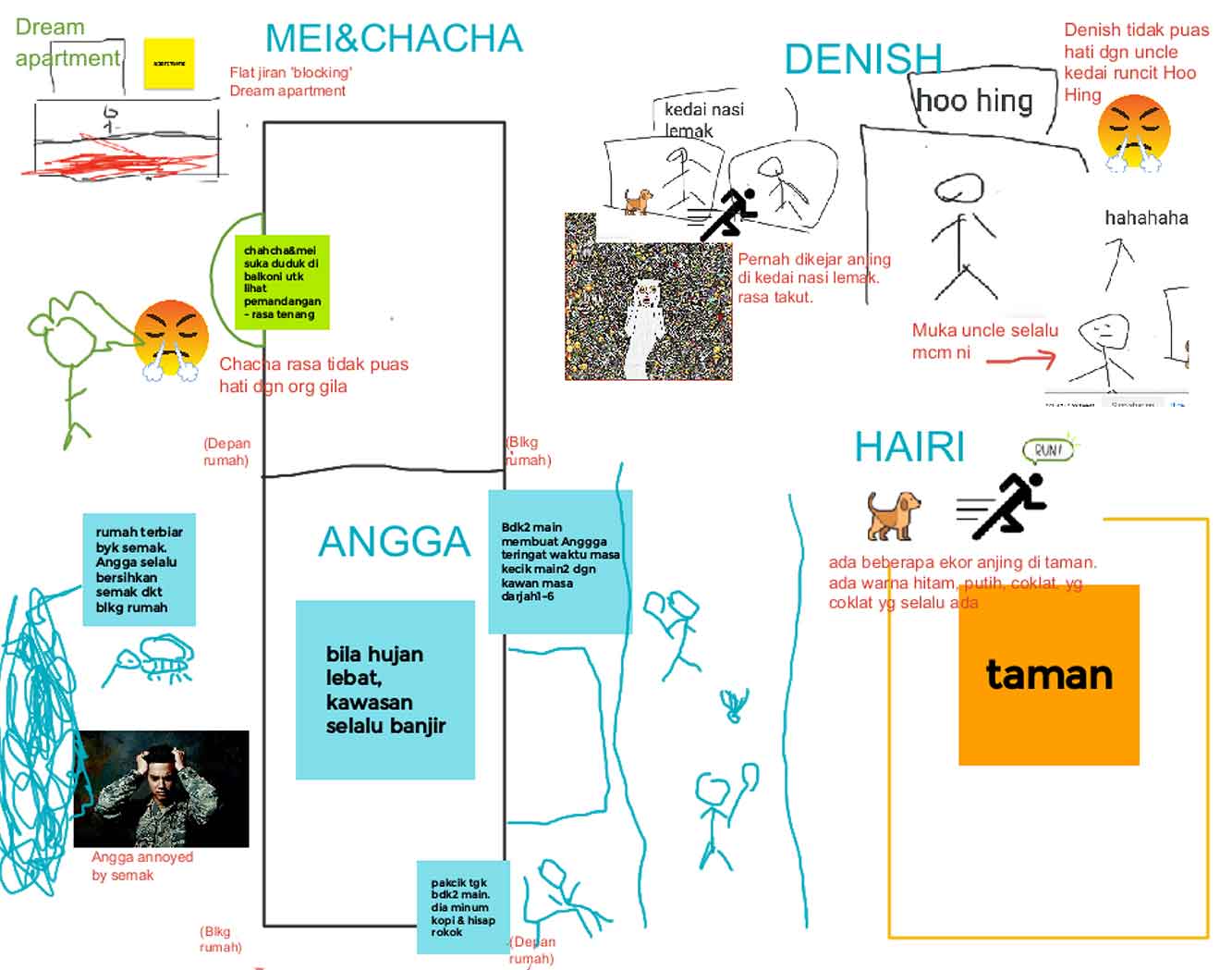
[2] Undesirable Nature in the City
In map [2], we see how students incorporated funny stories about being chased by dogs when attempting to access food stalls or the park (middle top and bottom right). In the bottom left, semak and mosquitos near their houses were described as annoying. One student described having to clear the undesirable weeds.
These stories about the negative aspects of nature were told alongside stories of other undesirable parts of or persons in their neighbourhood. The angry emojis point towards the “uncle kedai runcit” (convenience store uncle; top right) that certain students owed money to, and “kumpulan nenek bawang” (gossiping grandmas; top left) were gossiping neighbours that often scolded them.
Illustrated in the top left, two students who spent much time on their balcony during lockdown described the view of their dream apartment being blocked by their neighbours’ flat. This mirrors how their aspirations were limited by the lockdown.
What can we conclude from this? Our students did not think of Nature as one consistent category. Birds were proxies for freedom. Dogs were mentioned alongside “orang gila” (crazy people) or “uncle kedai,” that they avoided while out on the street. Crocodiles in the river (see map [4]) were just part of the excitement of wandering around the city.
Let’s dive deeper into nature as a free public space.
Physical Public Space
C: Adakah buat apa2 yang seronok untuk luang masa di rumah dalam masa PKPD ni?
H: Aku? Makin malas, makin gemuk je hahaha.
Nature matters to BJCK students in Chow Kit, but not because they value biodiversity. Instead, nature also referred to public spaces like tamans and padangs that students valued as free social congregation spaces for play. Even during the lockdown period, a couple of older students continued to use the river of life path for running and exercise (see map [4]).
Unlike most KL residents in the suburbs, students in BJCK walked everywhere prior to COVID lockdowns. They walked to friends’ houses, they walked to BJCK, and they walked to markets and parks. One major hindrance of the lockdown was the loss of being able to “jalan-jalan tengok dunia” (wander around and see the world).
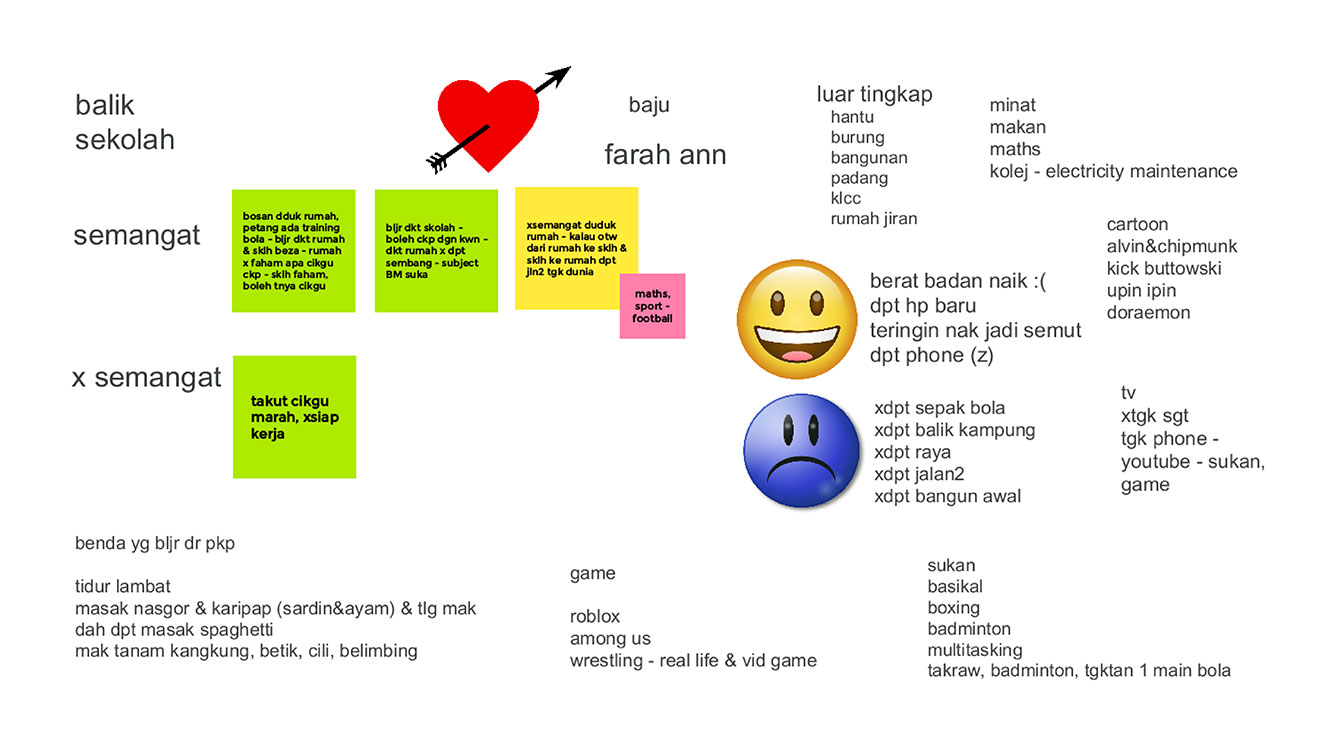
[3] A Deep Dive into Home Life under Covid.
Inability to access physical public spaces drove an overarching sense of disconnection and stagnation. In map [3], many students hoped to return to school not only for education, but so they “boleh cakap dgn kawan” or they could see the world “on the way dari rumah ke sekolah.” They found some respite through gardening and cooking with their mothers (see bottom left).
So where do these students go when the public spaces of Nature (and otherwise) are inaccessible?
Online Public Space
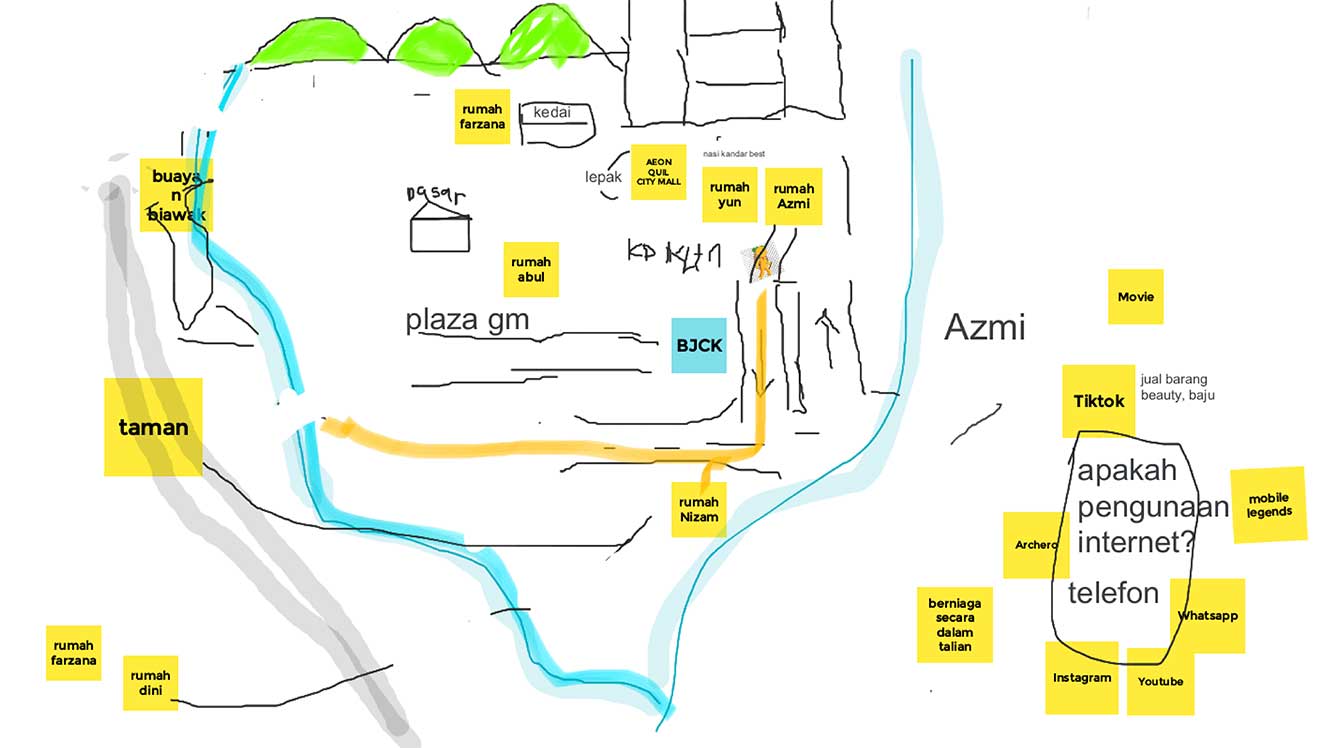
Restricted to the home, online spaces became the default public space. Students used online spaces mainly in interactive ways: multiplayer games, classes, workshops, social media, and income generation. They weren’t watching movies alone or reading the news; they were maintaining relationships through the internet.
[4] Spaces in the City and Spaces on the Internet
Most students played games that had strong multiplayer and open world features. Some older students used social media as a source of income. One student, previously worked at Pasar Chow Kit before non-citizens were banned. He now earned a commission by selling anything from clothes to cosmetics to durians on Instagram, Whatsapp, and TikTok.
Nature in its ecological sense was not something students aspired to reconnect to during lockdowns. However, community space was essential.
Accessibility
Access to nature is the crux of the Urban Biodiversity Frontier Challenge; how can we get to know our backyards if we cannot access them? We went into this project hoping to discover links or gaps in access to nature, but none of the students seemed particularly interested in discussing this. However, access to public spaces was a recurring theme.
Although students faced barriers such as poor internet, small homes, and income constraints, they were adaptive to circumstances. One example was getting goods from a shop where they owed money to “uncle kedai runcit.” Being unable to clear their debt, they would send different friends to make purchases instead.
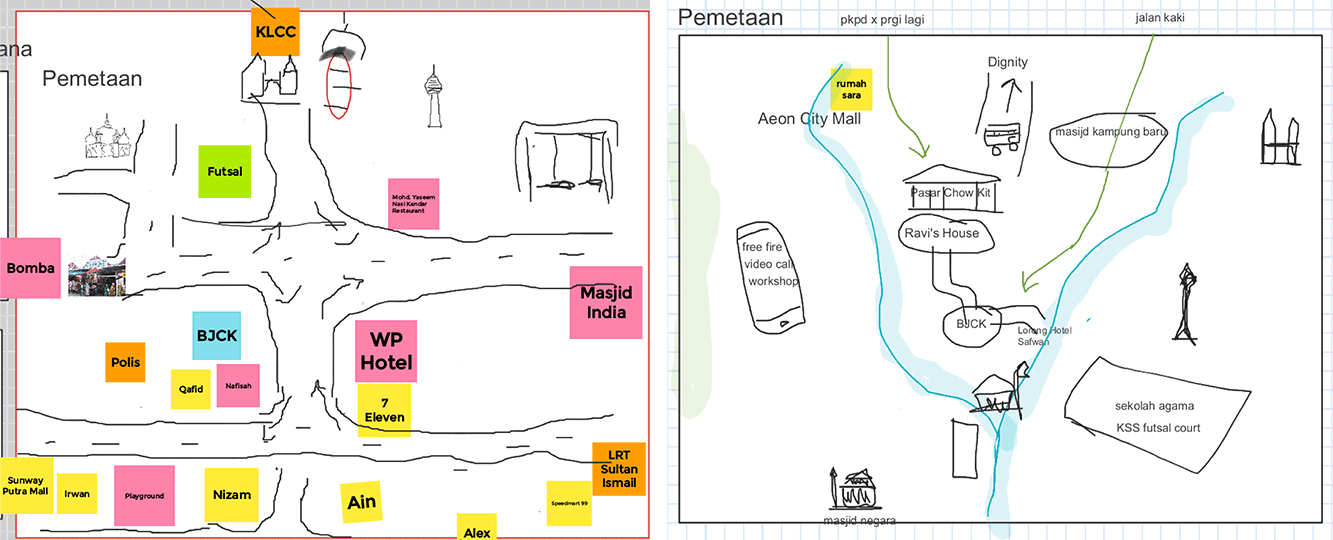
“[The students] added a local landmark, WP Hotel. Interestingly, they removed the original [template] drawings of several well-known landmarks i.e., KLCC and Masjid India from the map and made their own drawings.”
SM, Facilitator for [1.1]
[5] [6] Key spaces
Older students brought up issues of access to education and work opportunities. They thought deeply about their post-BJCK lives, schooling, and future life opportunities. Although excluded from certain forms of legal employment and education possibilities (due to class or citizenship restrictions), students readily thought and dreamed within their constraints.
Accessibility in terms of transport and walkability was good under normal circumstances due to the design of BJCK. In both maps [5] and [6], BJCK has several routes connecting students to their key physical spaces. They used BJCK as a safe congregating space before moving forwards into other spaces around the city. It was a relevant, free, and accessible public space to students, and was at the heart of every student landmark we explored. BJCK was important not just as a central physical location, but because it held their social world. Their closest friends were from BJCK, as were the networks they depend on.
More than beautiful national monuments like KLCC or the national mosque, BJCK was the key monument of their neighbourhood. Access and belonging are integral to placemaking. Placemaking is far more than space, it requires community.
As we think about incorporating nature into the city, we must consider: how do we make nature relevant to the everyday challenges of these residents? How do we create nature-based spaces that—like BJCK—are relevant, free, and accessible to these residents? We will be unable to sustain urban green spaces if residents do not value them as an important part of their neighbourhoods.
Conclusion
What is Nature in the city for?
The BJCK students show us that Nature in the city is not only important from a “biodiversity” lens, but as public spaces for leisure, livelihood, lifestyle, and social connections. COVID lockdowns have significantly disrupted the everyday lives of these students in Chow Kit, predominantly due to changes in the way they access their surroundings. However, these students are also resilient and resourceful because of their strong social networks. Online and offline public spaces offer their own benefits and challenges, but what is most essential in public space are the community networks supporting it.
The Urban Biodiversity Frontier Challenge aims to encourage residents to value nature. However, we must be open to the various and counter-intuitive ways residents relate to nature. For BJCK students in Chow Kit, we find nature is integral as a public space in the city, and public space requires community. So perhaps, as we think about Urban-Biodiversity in Kuala Lumpur, it is important that we think beyond nature in its ecological sense, and think about how we integrate nature into accessible public spaces founded upon existing community lifestyles.
Method: Citizen science in Mapping
Citizen Science is a broad term that has already been introduced in Urban Biodiversity Challenge Research Article. If iNaturalist documentation offers one way to conduct citizen science, community mapping offers another. The example offered here is meant to help us ask: what form of citizen science is appropriate to “citizens”? What form of citizen science best achieves our intended goals; is it to make policy inclusive, increase buy-in, or shape behaviour?
The goal of the Urban Biodiversity Challenge is to encourage and empower citizens to act upon their spaces, so the tools we create must mirror this dynamic in the map artefact. We wanted to explore how space can be understood beyond measured distances, so instead of building a base GIS map, we had student draw maps from scratch.
